Categories
Open-End Wrenches
An open-end wrench carries a different jaw size at each end. Because the jaw enters from the side it reaches fasteners a ring wrench cannot get over -- pipework, cable runs, anything with something above it -- at the cost of loading only two corners. Double-ended, single-ended and crowned patterns are listed here in metric and SAE size pairs.
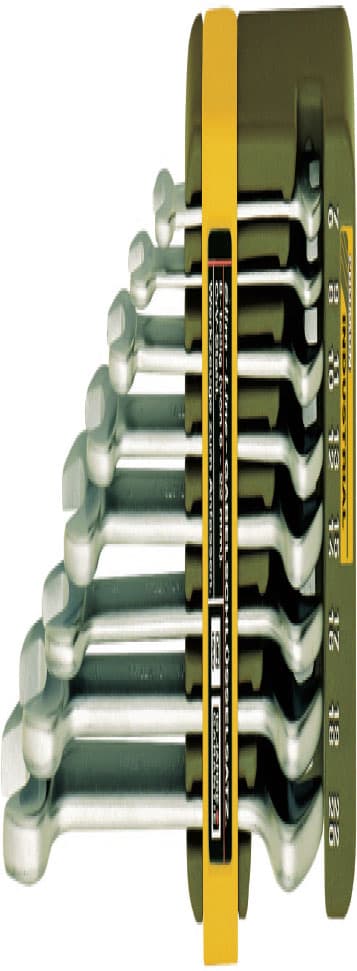
Proxxon 23800 Slim Open-Ended Spanner 8 pcs
Proxxon Industrial · Open-End Wrenches

Proxxon 23834 Open-Ended Spanner 10x11mm
Proxxon Industrial · Open-End Wrenches

Proxxon 23838 Open-Ended Spanner 10x13mm
Proxxon Industrial · Open-End Wrenches

Proxxon 23836 Open-Ended Spanner 12x13mm
Proxxon Industrial · Open-End Wrenches

Proxxon 23840 Open-Ended Spanner 14x15mm
Proxxon Industrial · Open-End Wrenches

Proxxon 23842 Open-Ended Spanner 16x17mm
Proxxon Industrial · Open-End Wrenches

Proxxon 23848 Open-Ended Spanner 17x19mm
Proxxon Industrial · Open-End Wrenches

Proxxon 23846 Open-Ended Spanner 18x19mm
Proxxon Industrial · Open-End Wrenches

Proxxon 23850 Open-Ended Spanner 20x22mm
Proxxon Industrial · Open-End Wrenches

Proxxon 23852 Open-Ended Spanner 21x23mm
Proxxon Industrial · Open-End Wrenches

Proxxon 23856 Open-Ended Spanner 24x27mm
Proxxon Industrial · Open-End Wrenches

Proxxon 23860 Open-Ended Spanner 30x32mm
Proxxon Industrial · Open-End Wrenches

Proxxon 23864 Open-Ended Spanner 34x36mm
Proxxon Industrial · Open-End Wrenches

Proxxon 23866 Open-Ended Spanner 41x46mm
Proxxon Industrial · Open-End Wrenches

Proxxon 23828 Open-Ended Spanner 5x5.5mm
Proxxon Industrial · Open-End Wrenches

Proxxon 23830 Open-Ended Spanner 6x7mm
Proxxon Industrial · Open-End Wrenches

Proxxon 23832 Open-Ended Spanner 8x9mm
Proxxon Industrial · Open-End Wrenches
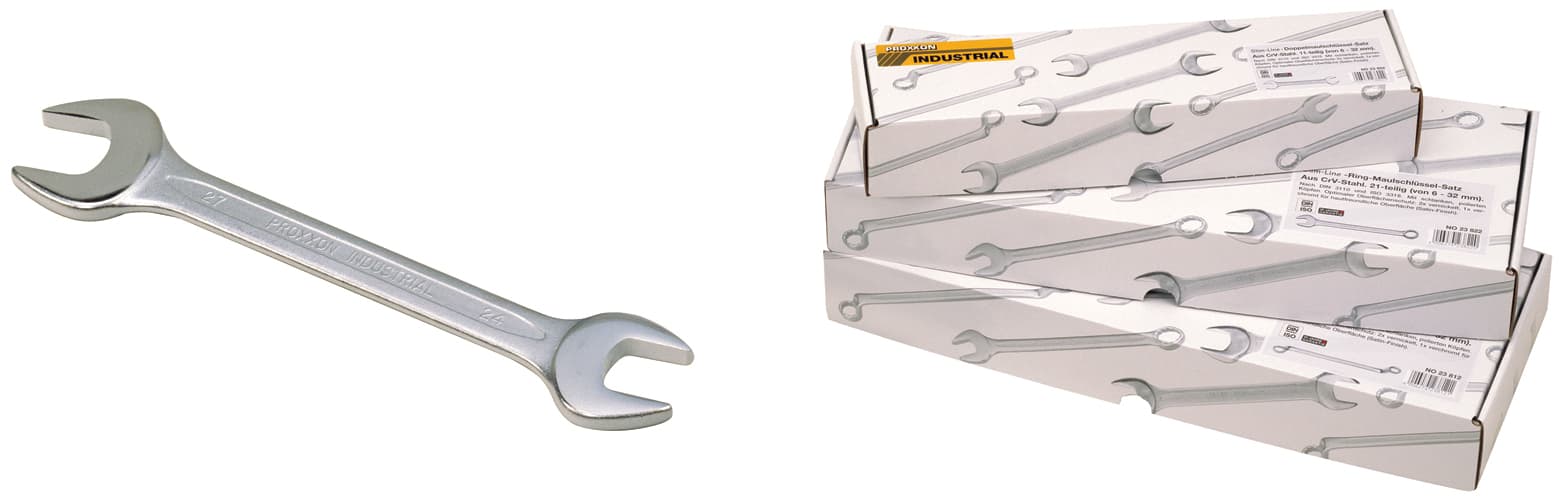
Proxxon 23802 Slim Open-Ended Spanner 11 pcs
Proxxon Industrial · Open-End Wrenches
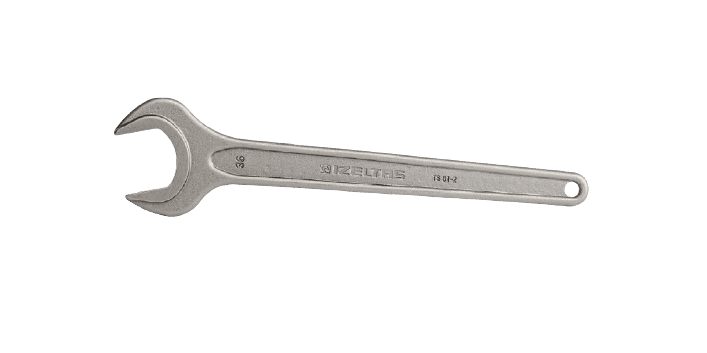
İzeltaş Single Ended Open Jaw Wrench 21 mm
İzeltaş · Open-End Wrenches
İzeltaş Single Ended Open Jaw Wrench 22 mm
İzeltaş · Open-End Wrenches
İzeltaş Single Ended Open Jaw Wrench 23 mm
İzeltaş · Open-End Wrenches
İzeltaş Single Ended Open Jaw Wrench 24 mm
İzeltaş · Open-End Wrenches
İzeltaş Single Ended Open Jaw Wrench 25 mm
İzeltaş · Open-End Wrenches
İzeltaş Single Ended Open Jaw Wrench 27 mm
İzeltaş · Open-End Wrenches
1–24 of 154 · page 1 / 7
Double-ended, single-ended and crowned
Most open-end wrenches here are double-ended, carrying a different size at each end in consecutive pairs (10×11, 12×13, 14×15) so that a set covers more sizes with fewer pieces. Short and long patterns split the range: long gives more moment from the same hand force, short works where the handle will not fit.
Crowned single-ended wrenches carry one size on a heavier body, for hard work at a single size and often with a slip-on handle. The same pattern appears in the 1000V insulated line, where it is the tool of choice on busbar connections in switchgear.
Why the jaw sits at 15 degrees
The jaw is forged at roughly 15 degrees to the handle. The reason is swing angle: lift the wrench off, flip it over and put it back, and the jaw lands in the middle of a 30-degree arc, so even a nut against a wall can be turned round.
An open jaw loads only two corners, which is why a badly seized joint should not be started with one. The right order is to break it loose with a ring or a socket and then spin it off with the open jaw. And a jaw that is oversize for the nut rounds the corners in a single pull.
Material and standard
Open-end wrenches here are forged from chrome vanadium and chrome plated. Jaw geometry follows TS 81 and TS ISO 10102, which fix the tolerance on the opening and the depth of the jaw -- so the play you feel in a non-standard wrench is a measurable difference, not an impression.
Frequently Asked Questions
How does an open-end wrench differ from a combination wrench?
An open-end wrench has a jaw at both ends in two different sizes; a combination wrench has a jaw at one end and a ring of the same size at the other. Open-end is about access, combination balances access against torque.
Can an open-end wrench break a seized bolt loose?
It should not. The open jaw loads two corners and rounds them on a seized joint. Break it loose with a ring or socket, then spin it off with the jaw.
Why is the jaw angled to the handle?
The 15-degree offset halves the swing angle when the wrench is flipped and refitted. On a nut against a wall or another part, that is the only way to keep turning it.
Why are the two sizes consecutive?
Consecutive pairs such as 10×11 and 12×13 let one set cover more sizes with fewer pieces. Some heavy-duty families skip sizes instead; both openings are written in every product name.
Where is a crowned single-ended wrench used?
For heavy work at a single size, often with a slip-on handle. In switchgear, the 1000V insulated version is the one used on busbar connections.